Electrical and Computer Engineering, M.S.
Master of Science
About this program
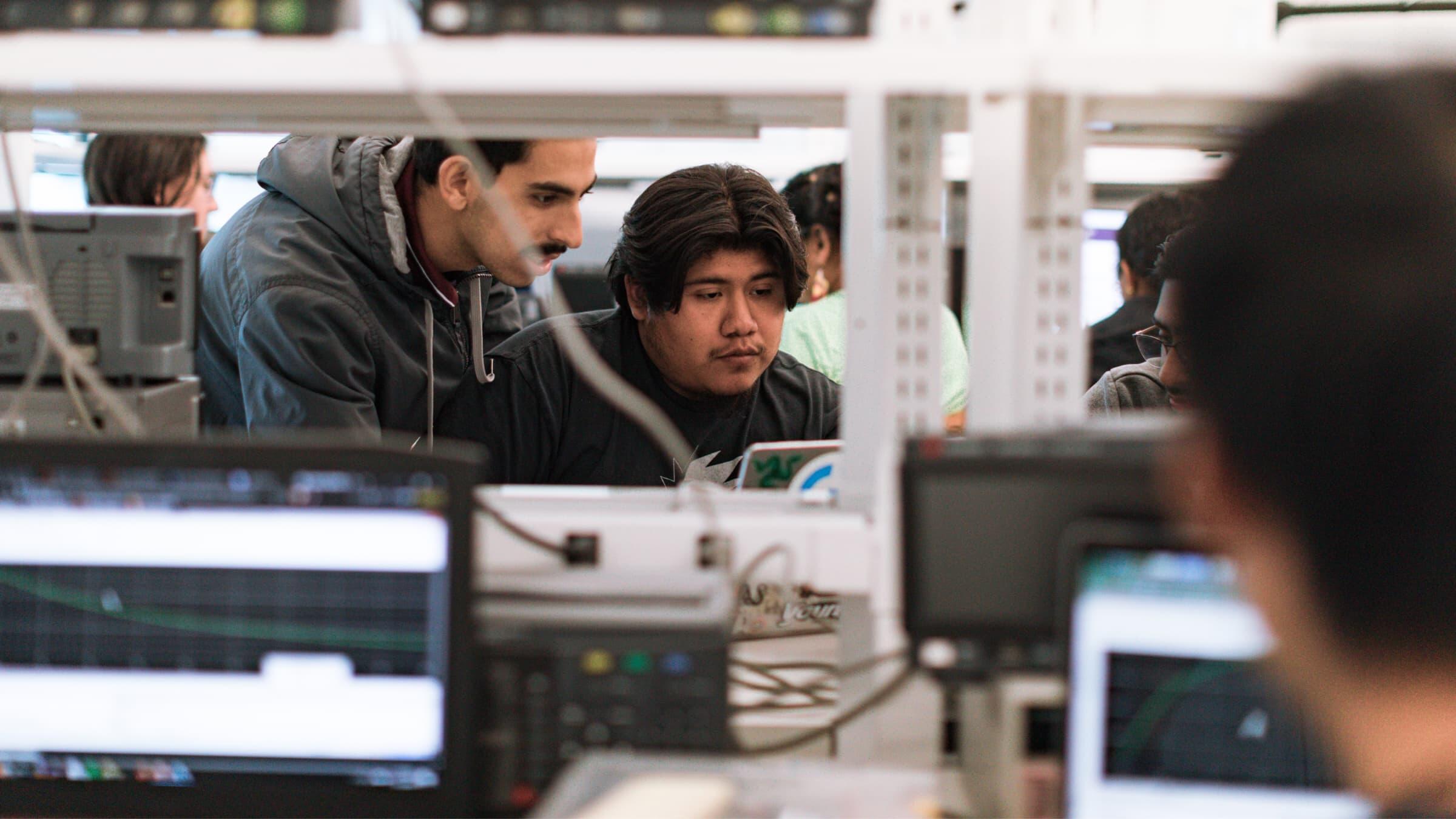
The Master of Science in Electrical and Computer Engineering lets you deepen your technical skills with hands-on training in electrical and computing systems. Over 30 units, you take core courses, labs and electives that suit your career goals. You complete an applied research project or thesis, and benefit from evening classes, close faculty support, and internship opportunities in the Bay Area. The program prepares you for industry roles or advanced doctoral study.
Program Curriculum and Requirements
Program Scope
The MSECE program in the School of Engineering offers courses and research opportunities in the areas below:
- Embedded systems, cyber-physical systems (CPS), and their applications
- Designing reliable, energy-efficient, high-performance computing circuits in emerging nanotechnologies
- Analog and radio frequency circuits and systems for biomedical applications
- Hardware security, Internet-of-Things (IoT) & CPS security, and embedded system design security
- Neuromorphic computing
- Designing, prototyping, and testing mechatronic and robotic systems
- Mobile computing, deep learning acceleration, and distributed edge computing
- Wireless communications
Research in these areas is carried out in Nano Electronics and Computing Research Laboratory (NeCRL), Intelligent Computing and Embedded Systems Laboratory (ICE Lab), SF Bioelectronics Laboratory, Analog Design Center, Mobile and Intelligent Computing Laboratory (MIC Lab), AI-LAMP: AI Lab for Augmented Multimodal Perception, Personalized Health and Assistive Technologies Laboratory (PHAST Lab), Gator Engineering Education Research Lab (GEER Lab), and Controls for Assistive and REhabilitation Robotics Lab (CARE Lab).
Program Learning Outcomes
- Develop critical thinking for research findings and engineering practice in their field of expertise and the capability to be able to clearly articulate and apply such knowledge in their research and practice.
- Develop effective writing skills for both informal and formal professional communications and skills to orally present scientific material to a broad range of audiences.
- Demonstrate the ability to work effectively in teams on complex electrical and computer engineering problems.
Admissions Information
In addition to the general requirements for admission, this program requires:
- Two letters of recommendation from persons familiar with the applicant’s previous academic work or professional accomplishments.
Applicants must:
- B.S. in Electrical or Computer Engineering from an ABET-accredited program, or a B.S. and the equivalent of the following courses:
- Math: MATH 226, MATH 227, MATH 228, and MATH 245
- Physics: PHYS 230/PHYS 232 and PHYS 240/PHYS 242
- Engineering: ENGR 205, ENGR 206, ENGR 213, ENGR 301, ENGR 353, ENGR 356/ENGR 357, ENGR 378, and ENGR 478
Applicants with a GPA Deficiency: At the time of admission to the University, the minimum GPA must be 3.0 out of 4.0 for the last 60 units of the applicant’s study. An applicant with a GPA higher than 2.8 but less than 3.0 may fill out a University waiver form for this requirement and submit it with the other Engineering requirements to:
Engineering Graduate Program Coordinator
School of Engineering
1600 Holloway Avenue
San Francisco, CA 94132
For the applicants with mainly non-English preparatory education, a minimum score for TOEFL (Institution code -4683) is 550 for paper-based and 80 for Internet-based is required. Alternatively, this requirement may be satisfied by a minimum IELTS of 7.0 or PTE Academic of 65.
Non-Engineering or non-major applicant holding a B.S. degree:
B.S graduates from non-engineering programs, such as math, physics, or science, may be admitted as conditional graduate students. Please review each engineering graduate programs minimum course admission requirement that needs to be met. These courses can be taken by enrolling in SFSU Open University to meet graduate student status upon completion.
- Applicants must have a record well above the university admission requirements and be able to clearly demonstrate their potential in Engineering.
- Conditional graduate students may apply for advancement to classified graduate status after satisfying minimum prerequisites.
- No conditional admissions are issued to international students
Graduate Record Exam
GRE scores are not required.
Fall: May 1
Spring: November 1
Ready to apply? Visit the Graduate Students page to get started.
We’re Here to Help
Questions about the program or how to apply? Don’t hesitate to reach out.
Hamid Mahmoodi
- Professor