Planetarium celebrates half a century as SF State’s direct connection to the universe
New funds will help the Charles F. Hagar planetarium continue its 50-year legacy as a beacon of education and community
- By Kanaga Rajan
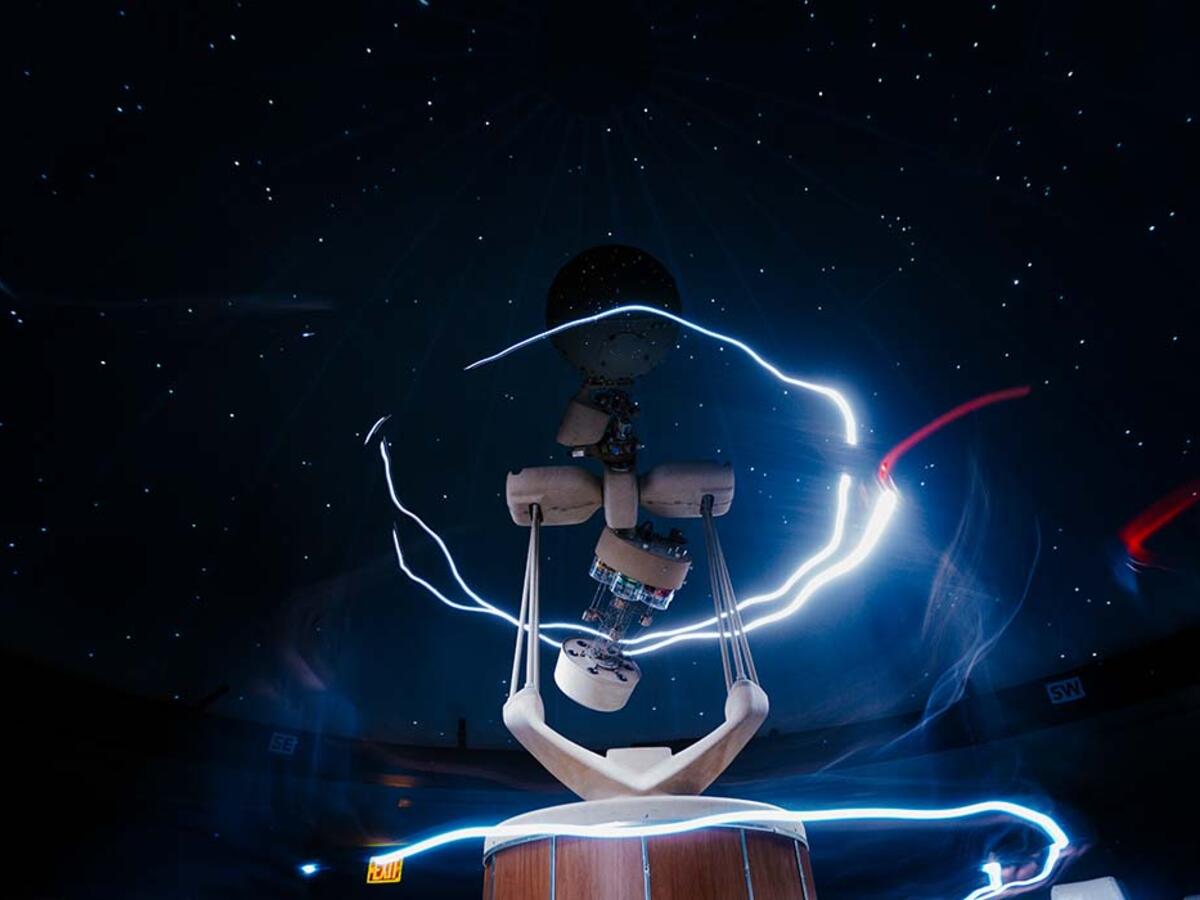
“When we dim the lights and the stars come on, you can just hear the gasps all through the room,” said Physics & Astronomy undergraduate Sergio Lopez of the public planetarium shows he presents in Spanish at San Francisco State University’s Charles F. Hagar Planetarium. “I think that’s my favorite part.”
Students like Lopez are carrying on and evolving the legacy started by astronomy professor Charles Hagar when he designed the planetarium (and observatory) in 1973.
The planetarium was recently awarded $1.5 million to refurbish the facility from the Heising-Simons Foundation. The Heising-Simons Foundation is a family foundation that works with its partners to advance sustainable solutions in climate and clean energy, enable groundbreaking research in science, enhance the education of our youngest learners, and support human rights for all people. The fortuitous timing of the award — which coincides with the planetarium’s 50th anniversary — didn’t go unnoticed by Planetarium and Observatory Director Adrienne Cool.
“It’s no small feat for this planetarium to have been able to do what it does for 50 years,” she said.
Physics & Astronomy students take classes there, but it also offers free shows to anyone, including the public.
“We’re proud of the fact that this planetarium has provided a training ground and a community for so many people, and that so many have gone on to become science educators in the Bay Area and beyond,” Cool said.
The renovations will introduce a modern star projector that will produce an accurate night sky of 9,500 stars, details of the Milky Way and more. (The current star projector has been there since Hagar’s days.) Complementing the star projector will be full-dome video that enables planetarium presenters to take visitors on virtual trips through the Solar System, Milky Way and beyond, and display images from the James Web Space Telescope and other observatories around the world. There will also be a new dome as well as new control and audio systems, lighting and seating.
“Even the absolute top-of-the-line video projection still doesn’t look as good as the stars made by the old-style [star projector], which is more of a pinhole camera. [It’s basically a] ball with zillions of holes. Those stars look more like realistic stars,” said Planetarium and Observatory Technician Jim Gibson about the decision to continue using a star projector. It’s an important distinction, he explained, because many local planetariums only use video.
Since 1973, the planetarium has served approximately 100,000 people. Currently, around 1,800 people visit annually — and while many are SF State Physics & Astronomy students, more than 1,000 are students, faculty and staff from outside of the department, K-12 school children or members of the community.
The planetarium/observatory alumni network — alums trained as students to use the facilities — numbers in the hundreds and includes staff members at the California Academy of Sciences and the Astronomical Society of the Pacific along with community college and high school teachers.
Over a decade ago, Gibson began offering planetarium workshops to teach students how to use the planetarium equipment and lead planetarium shows. Physics & Astronomy graduate student Shvetha Suvarna Chynoweth enrolled because she wanted to navigate the night sky herself. But the experience became personal when it helped her connect with her family in a new way.
Given different interests and generational gaps, she found it difficult to relay her enthusiasm for her graduate work to her family. The workshop helped her connect their love of astrology, which for her family has religious connections, to her scientific astronomical interests. “This class helped me figure out how I can start tying things together — the things that they are interested in versus what I am interested in — to bridge the gap. It might not be completely connected but it’s how you get them to relate to stuff they really respect,” she said.
This type of connection is the goal of the monthly bilingual Spanish-English Noche de Estrellas planetarium/observatory public events led by Lopez and other students. The graduate school-bound Lopez, a native Spanish speaker, says these events helped him practice talking about astronomy in Spanish and to non-expert audiences.
Cool emphasizes that public planetarium shows for school children are all free, as they were when Hagar began 50 years ago — and she has no intention of changing this. She and Gibson anticipate that the renovated facilities will lead to increased student participation, broader student training opportunities, and enhanced visitor experiences.
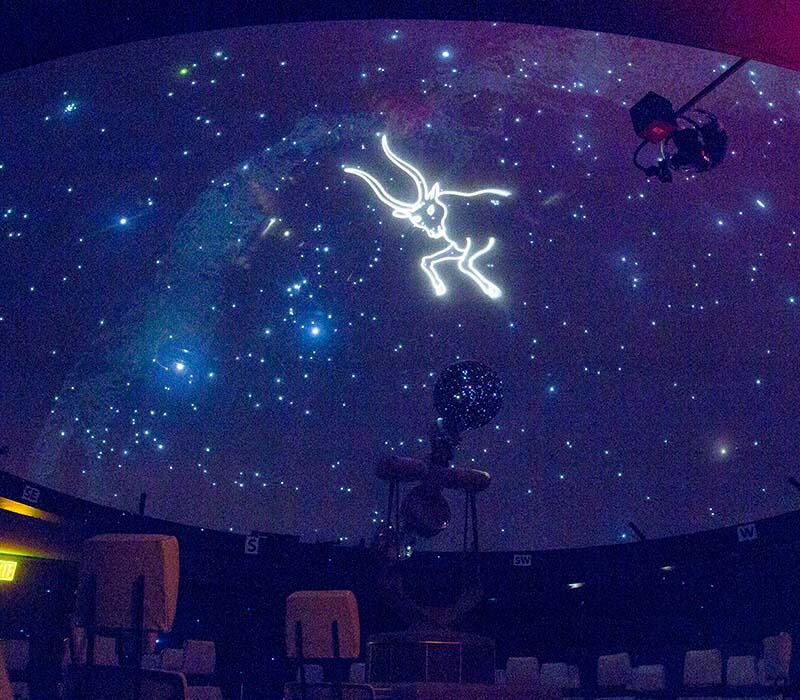
“As the audience, you are looking at the universe as yourself. Here’s me seeing the stars, the sun, the moon and the planets. It is highlighting your relationship to the cosmos,” Gibson said. Understanding how the universe began is a very abstract concept. “Whereas when you’re in the planetarium, that’s what you see. If you go out at night, boom: Here’s your exact direct connection to the universe.”
The planetarium and observatory welcome everyone to visit. Learn more about the planetarium and observatory, get schedules for public shows or make a reservation.