Leticia Márquez-Magaña named a 2023 American Association for the Advancement of Science Fellow
The SF State Biology professor is being honored for bacterial research into gene expression and health equity
- By Kanaga Rajan
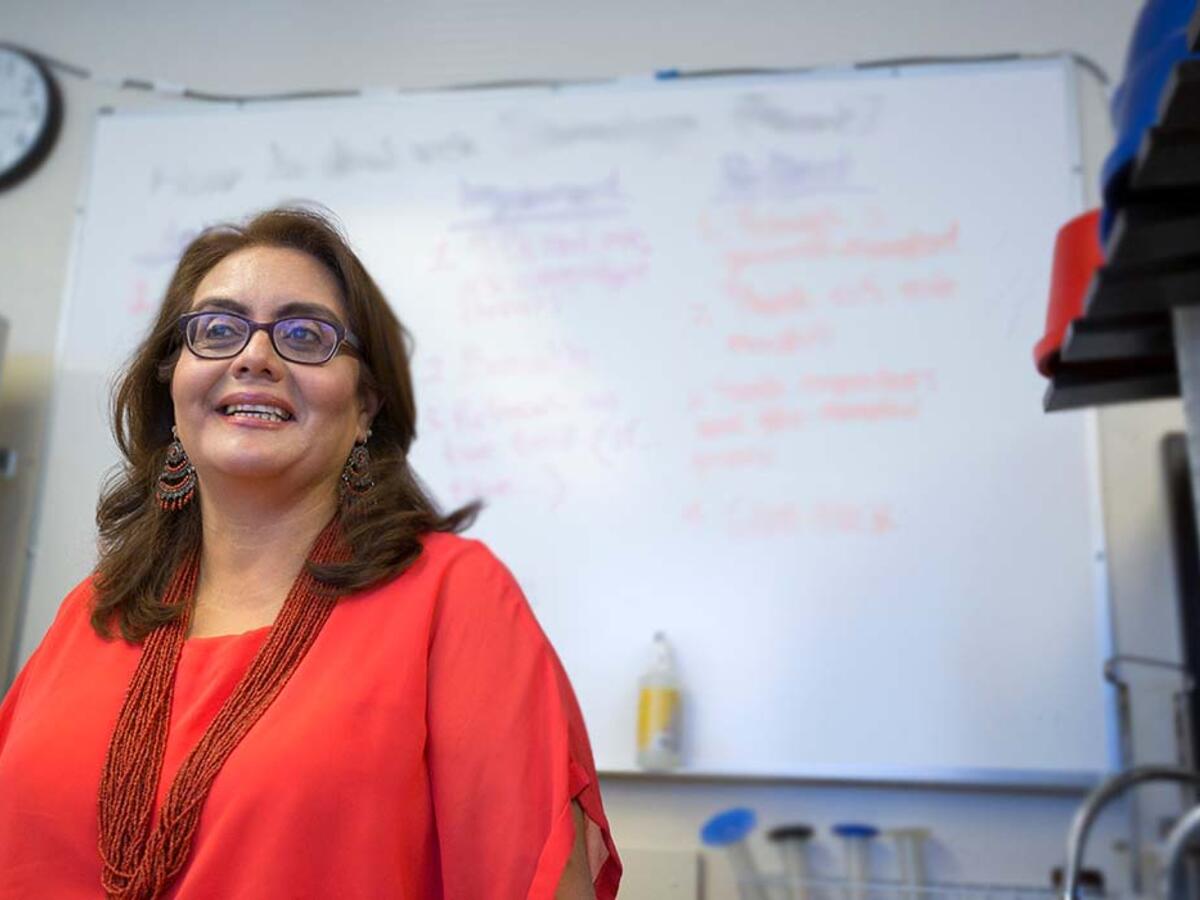
For San Francisco State University Professor of Biology Leticia Márquez-Magaña, it’s all about community. Her health equity research, educational efforts and prominence as a public figure in the scientific community — none of it’s about her at this stage in her career.
“It’s all about the little Leticias. They need to see what is possible in order to be what they usually don’t see,” she explained. This community mentality was instilled in her at a young age by her family and Mexican culture.
Today, Márquez-Magaña has been recognized as a Fellow of the American Association for the Advancement of Science (AAAS), the world’s largest general scientific society and publisher of the Science family of journals. She is among 502 scientists, engineers and innovators spanning 23 categories who are being honored for their scientifically and socially distinguished achievements throughout their careers.
Márquez-Magaña is the latest SF State faculty member to receive this honor and one of three California State University (CSU) system-affiliated researchers in the 2023 cohort. She joins 12 SF State faculty elected to this status since 1874. The earliest SF State honoree was recognized in 1947 (when SF State operated under the name “San Francisco State College”). The last SF State fellow before Márquez-Magaña was Professor Emerita of Biology Jan Randall in 2015.
Márquez-Magaña says learning of the honor had her feeling “surprised, in a good way,” explaining that she’s had many career experiences that made her feel invisible. “Maybe to you, I look like a scientist, but for other people, it doesn’t align,” she said. “The other thing is that I am often dismissed because I say things that are triggering because of my self-recognized role to cause discomfort, to create change.”
AAAS honored Márquez-Magaña for her contributions to the fields of bacterial gene expression and health equity research. Though now known for her explorations of health equity issues, it took Márquez-Magaña a while to get there, largely because traditional academia tried to convince her that the “best science was not tainted by social relevance.” But she always doubted that.
A real turning point came in 2005. While teaching a course about health disparities in cancer, Márquez-Magaña saw data about total cancer deaths since 1975. Shockingly, cancer death among Latinas wasn’t collected until the early 1990s when a national law passed in 1993 mandated inclusion of women and minorities in federally funded clinical studies.
“I remember thinking, ‘Gosh, they don’t even care if we’re dying.’ … I’m part of the problem, and that freaked me out,” she said.
Márquez-Magaña joined SF State in 1994 and established the Health & Equity Research (HER) lab in 2007. The lab is now co-led by SF State Assistant Professor of Biology Cathy Samayoa (B.S., ’09; M.S., ’11), who trained with Márquez-Magaña as an SF State student. Together they lead a group that combines researchers’ (usually students’) lived experiences with accessible molecular biology tools to tackle complex health problems. Research projects include, but are not limited to, identification of factors contributing to cellular aging in Black communities, biomarkers in Latinas with breast cancer, nature-based stress interventions that are culturally inclusive and anti-racist, and more. Researchers bring their insider knowledge — social, linguistic and navigational skills — for community-engaged research.
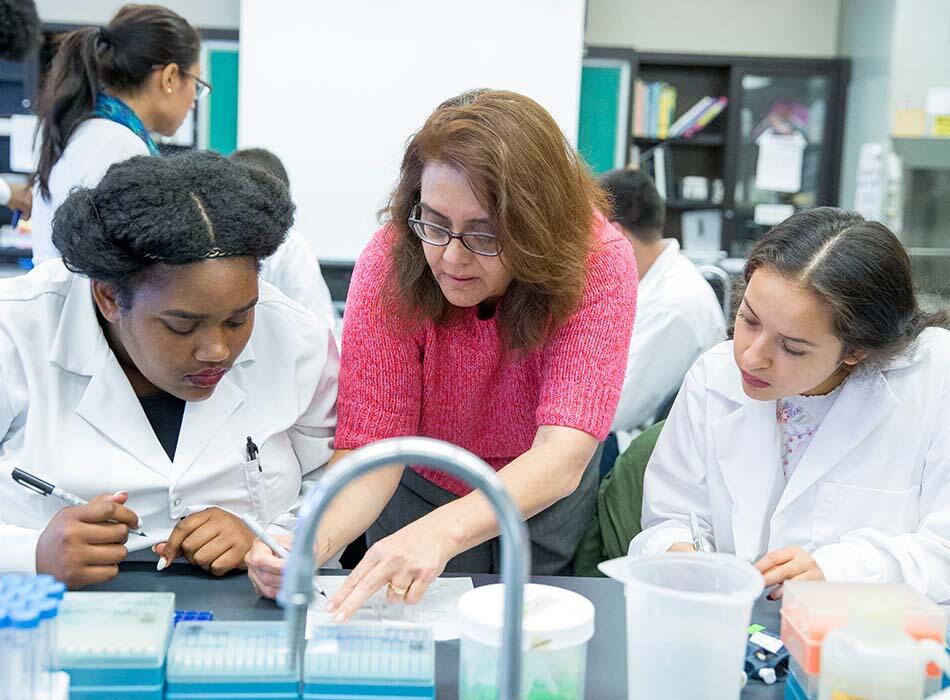
Márquez-Magaña working with Destinee and MC, two scholars in the first SF BUILD cohort.
“The lab’s current motto is ‘ground truthing community knowledge through science.’ What really shifted for us is that it’s not about [faculty] research questions. It’s about what the community wants to know,” she said.
The lab is a space with many tools and psychosocial support that students who are not represented in science need to realize, optimize and implement their scientific vision. Although each researcher brings their individual skills and wisdom, research is done collectively. This allows for better work across disciplines and encourages a communal approach to research that Márquez-Magaña has always implemented with colleagues.
“Others saw science as a battle: ‘We’re going to beat that research team’,” she shared of earlier experiences at research institutes. “It just never was a battle for me. I always knew that we were better working together. I think that’s because I was part of a minoritized group.”
In 2014, Márquez-Magaña helped establish the National Institutes of Health-funded SF BUILD to enhance the diversity of the biomedical research workforce. As SF BUILD’s lead principal investigator and core leader, Márquez-Magaña collaborates with faculty and staff at SF State, UC San Francisco and community organizations to transform teaching and research environments. Recently, the CSU’s STEM-NET hired Márquez-Magaña to bring more health equity research training and funding to the 23-school system.
“The CSU is where the workforce gets developed. What does the workforce do? The California workforce services the needs of Californians. We can do research that’s meaningful and impactful in our communities,” she said.
Learn more about SF State’s Department of Biology and SF BUILD.