Two new exoplanets discovered in SF State astronomer’s 100 Earths Survey
Astronomy & Physics Assistant Professor John Michael Brewer detected rare types of planets and planetary systems thanks to a precise new tool
- By Kanaga Rajan
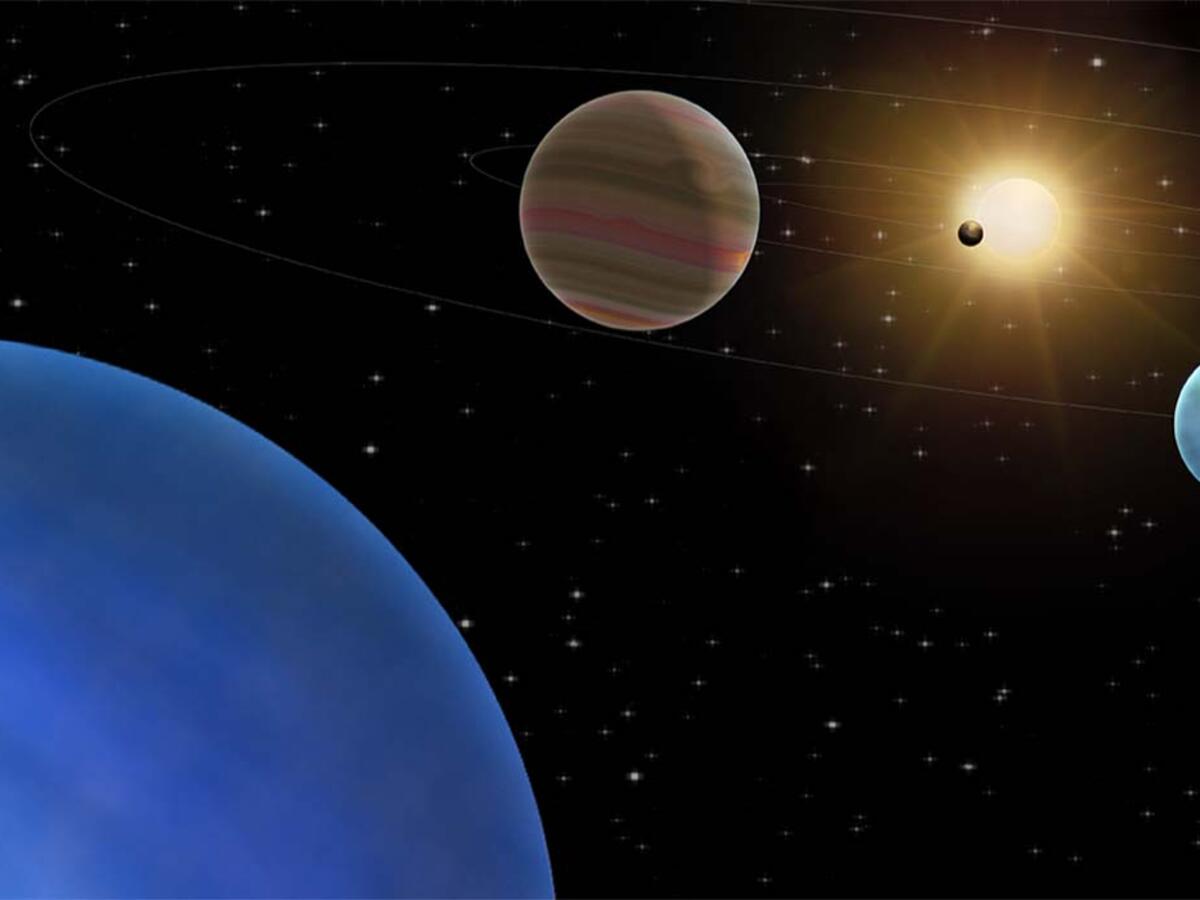
Have you ever considered the stars in the night sky and wondered how many are orbited by planets like ours? San Francisco State University Astronomy & Physics Assistant Professor John Michael Brewer has … and he’s getting answers. He’s the latest in San Francisco State’s long list of planet hunters hoping to find new planets comparable to our Earth. He and his collaborators are inching closer to their goal with their new discovery.
Their latest report describes the detection of two new exoplanets in what was believed to be a two-planet system. The new exoplanets are the first to be discovered in the 100 Earths Survey, a project led by Brewer that uses an extremely precise new tool to detect planets previously beyond scientists’ reach. The findings have been accepted to the Astronomical Journal but the preprint is already available on arXiv.
The new exoplanets orbit rho Coronae Borealis, a star about the same size as our sun. Two large planets were already known to orbit this star. But the new survey discovered a third planet that’s much smaller (four times the mass of the Earth, which is considered small) with a 13-day orbit and a fourth planet that’s similar to Neptune (20 Earth masses) with a 280-day orbit.
“If we’re going to find an Earth-like planet, it has to be around a sun-like star. This is exactly the kind of star that we want to be looking around. But we haven’t been able to find small planets like Earth in long-period orbits around these types of stars before,” Brewer explained. “This one study doesn’t tell us [whether our solar system is unique], but at least it tells us that we can start seeing whether or not there’s [Earth-like] planets [around sun-like stars].”
Usually astronomers find small Earth-like planets with orbits less than 40 days around small stars. But the Earth orbits the sun (which is slightly more massive than rho Coronae Borealis) every 365 days. Although the new small planet is uninhabitable because it’s too close to its star, its discovery shows that the new survey expands the types of planets scientists can detect.
Prior research found that the planetary system around rho Coronae Borealis consisted of a large planet (330 Earth masses) with a 39-day orbit discovered in 1997 and a second smaller one (25 Earth masses) with a 102-day orbit found in 2016.
The two new planets and the previously discovered planets make up a four-planet system that is not arranged like our solar system, where planets grow in size the further away they are from the sun. However, this four-planet system’s arrangement is rare, giving hope that the 100 Earths Survey might be able to detect other uncommon planetary systems.
“Now we’re starting to look at what planet architectures really look like instead of just the glimpses we’ve been able to see until now,” Brewer said, explaining that these types of systems were below detection limits. The 100 Earths Survey started in 2019 and not only confirmed the first two planets and discovered the two new ones, it also found hints that there might be more planets in this system. It managed to do all this with just 163 observations in under three years — which is fast compared to previous surveys. The planets detected in 2016 required 800 observations over eight years to find one new planet and one old.
The quick pace of discovery was made possible by using EXtreme PREcision Spectrometer (EXPRES), a spectrometer housed at the Lowell Observatory’s Lowell Discovery Telescope in Arizona. Designed by former San Francisco State Assistant Professor and alumna Debra Fischer, EXPRES measures light from a star to measure changes in its velocity as it is tugged around by its planets. Though EXPRES is not the first device of its kind, its level of high resolution and ability to cut through noise in measurements is matched by only a few other spectrographs in the world.
“We’re starting to probe the space where we expect to find habitable planets,” Brewer said. “Hence the name of the 100 Earth Survey. We want to find a bunch of Earth-like planets.”
Brewer started his master’s degree at SF State before moving to Yale University to work on his Ph.D. with renowned planet hunter Fischer. Now that he’s leading the project, Brewer wants to involve more of his students. The 100 Earths Survey and EXPRES have been collaborative since the beginning, providing a great learning opportunity for students, Brewer explained, noting that he’s already looping his students into tangential projects.
“There’s only 15,000 astronomers in the world,” Brewer said, explaining why it’s important for SF State students to mingle with the science community early in their career. “Everyone knows something slightly different, and everybody brings something else to the table. And that’s crucial to building students’ thinking whether they go on to a Ph.D. program or industry.”