Graduate Programs
The department offers the Master of Science in Physics and the M.S. in Astronomy & Astrophysics. These programs serve students who seek advanced knowledge in physics or astronomy for application in physics/astronomy related industries, for preparation to continue graduate work elsewhere towards the doctoral degree, for service as museum/planetarium docent or technical staff at a research institute, and for work leading to teaching credentials which require a master's degree.
Master's Degree Programs
Master of Science in Astronomy and Astrophysics
The Master of Science in Astronomy & Astrophysics involves advanced coursework in classical mechanics, stellar astrophysics, radiative processes in astrophysics, extragalactic astronomy & cosmology, and data and statistical analysis techniques for observational astronomy research. Specialized electives are frequently offered in special & general relativity, plasma physics, and computational physics. Students may select from 3 culminating experience options: a Master’s Thesis, a Culminating Project, or a Comprehensive Oral Examination.
Master of Science in Physics
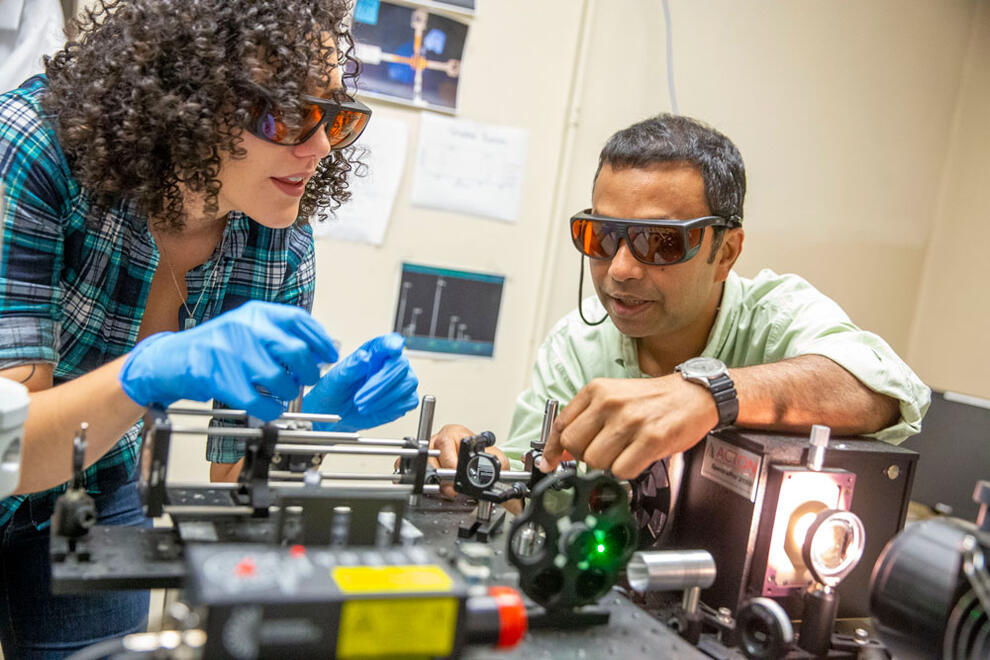
The Master of Science in Physics involves advanced coursework in classical mechanics, electromagnetism, quantum mechanics, statistical mechanics, and theoretical physics. Specialized electives are frequently offered in lasers and quantum optics, photonics and nanomaterials, advanced laboratory techniques, special & general relativity, plasma physics, and computational physics. Students may select from 3 culminating experience options: a Master’s Thesis, a Culminating Project, or a Comprehensive Oral Examination.
Need more information?
Contact one of our Graduate Coordinators.
Adrienne Cool, Ph.D.
- Professor
- Director of Charles F. Hagar Planetarium and SFSU Observatory
- Astronomy Graduate Coordinator
Maarten Golterman, Ph.D.
- Professor
- Physics Graduate Coordinator