Faculty Spotlights
Current Faculty Spotlight
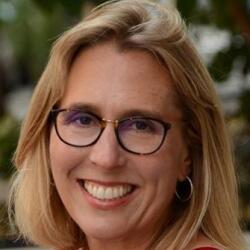
Susan Cholette, Ph.D.
Professor of Decision Sciences
Director, Center for Ethical & Sustainable Business
Lam-Larsen Distinguished Teaching Professor 2021-2023
Decision Sciences Professor Susan Cholette’s early career was industry-focused - her research background in building large scale economic models that tracked greenhouse gas emissions and her desire to stay rooted in the Bay Area led to positions in supply chain consulting and project management. Through a stroke of luck, Cholette was presented with an opportunity to work in academia. Today, after two decades as a professor, she still brings her industry experiences into the classroom as a powerful tool for teaching students to build skills in forecasting, inventory management, and more.
Cholette’s courses are described by students as highly engaging, experiential, and fun. “I try to keep my courses from becoming just another set of lectures,” she says. “When we are in the classroom, be it in person or Zoom breakout rooms, I make use of group labs for experiential learning.” Tackling more complex concepts, like linear programming, with simulations and interactive games encourages deeper understanding in the classroom and enhances her students’ knowledge of real-world applications.
One way Cholette keeps students engaged with current issues in supply chains caused by the COVID-19 pandemic is by using a simulation that looks at how to distribute vaccines during an emergency, when both supply and demand are in flux. The skills gained through exercises like this one will serve students in their careers, Cholette believes. “There are jobs to be had fixing these problems in both the short and long term to make sure that businesses are more resilient when the next crisis strikes.”
Principles of sustainability – an area of focus in Cholette’s research – are also integrated into her course curriculum. “I’m one of those old-timers that started studying climate change back in 1992, but then I was focused more on large-scale models,” she reflects. “Now I focus on what individual businesses can do to reduce their carbon footprint.” During her supply chain management lessons, Cholette asks students to research a product of their choice and the journey it takes from production to purchase. “They calculate the carbon footprint associated with this journey and consider alternative ways of getting this product to their customers. I enjoy seeing what products appeal to students.”
It is no surprise that Cholette recently received an inaugural Lam-Larsen Distinguished Teaching Professorship Award in recognition of excellent teaching, innovative instruction, and significant contributions to improving the curriculum at our college. “Awardees receive a generous stipend to mentor junior faculty who want to improve something about their teaching, and we will work together in a one-on-one setting over the course of the year to work on these goals,” she says. “This is an amazing opportunity that I wish I could have had as a junior faculty, so I’m grateful to our generous donors for making this happen for our next generation of instructors.” In addition to mentorship, Cholette and other awardees lead workshops open to all SF State faculty. One recent session involved playing Cholette’s vaccine distribution game as a way to learn about decision-making and the impact of interactive games on student engagement.
Aside from her teaching and mentorship roles, Cholette is also the new director of the Center for Ethical and Sustainable Business, where she works with the college’s Career Services & Professional Development team, alumni, and local employers to mentor students and help them pursue internships and jobs that will enable them to address and solve issues related to social justice and the environment. “Students are concerned about the planet’s future, and while organizing the occasional beach clean-up is fun, we have to find ways to involve them that will directly translate into helping them launch future careers.” Additionally, Cholette sees opportunities to work on sustainability through interdisciplinary engagement with students from other colleges at San Francisco State.
Visit our Decision Sciences Department page to learn more about the programs and courses we offer in this field. Learn more about the Center for Ethical & Sustainable Business on our website.
Past Faculty Spotlights
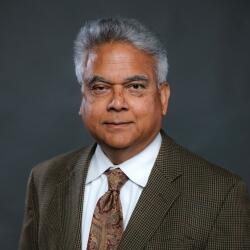
Lutfus Sayeed, Ph.D.
Professor and Chair of Information Systems
Professor Lutfus Sayeed discovered his passion for teaching and interest in quantitative subjects while working as a school teacher and market research analyst. Pursuing his doctorate in the early days of the Internet, Sayeed found a true fascination with the interaction between information management and digital technology. “Information Systems is a dynamic field,” he says. “Instructors and researchers in the area have to continuously update their knowledge base and skills. That is very appealing to me.”
Sayeed’s research focus includes analytics and artificial intelligence-based information technology applications in healthcare and education, information sharing in groups using online communication tools, and environmental impacts of information technology. Recently, he has explored data analytics applications in healthcare and online education – two areas experiencing rapid growth.
A pioneer of research on online communication tools, Sayeed’s 1997 article "Virtual teams versus face-to-face teams: An exploratory study of a web-based conference system," published in the Decision Sciences Journal, is one of the most cited articles in business and management education. It received recognition for being among the 15 most downloaded articles in the 50-year history of the Decision Sciences Journal. Though at the time online communication was not as developed as it is today, Sayeed says his research was inspired by the Internet’s potential to enable the continued use and development of online conferencing and meeting tools.
He believes the increased reliance on these digital tools will continue even when the pandemic is over. “Tools such as Zoom have become ubiquitous because of the convenience provided to us through incorporating new features while adapting to needs of the changing nature of the workplace,” says Sayeed. “These tools keep changing and evolving as a result of the lessons learned from the interaction between the user and the technology itself.”
Sayeed also credits technology for playing a major role in the Lam Family College of Business’ successful transition to virtual learning and operations. “I think we have done a great job in our transition to online teaching due to the pandemic,” he noted. “The University has been very proactive by providing faculty with exposure and access to the right technology and training.” In his own courses, Sayeed conducted a virtual trip to a business as a way to break the monotony of lectures, used Zoom breakout sessions for group collaboration, and shared recordings of classes to increase flexibility.
For others trying to build a community virtually, whether at work or in the classroom, he recommends sending periodic newsletters, taking virtual field trips, building a classroom website or blog, and moderating a discussion board - moving away from simply replicating a face-to-face environment, and instead embracing the virtual tools available. There are also strategies that can be easily translated from in-person to virtual environments, like building trust. “Just like in the offline environment, students' or employees' performance needs to be recognized. The facilitator of the meetings or conferences has to take a very active role in implementing trust and recognition in an online environment.”
Ultimately, Sayeed believes this experience with online communication tools will be an asset to students as they interact in the professional world. “Regardless of their major or concentration, our students have to be technology savvy before entering the job market,” he says. “Businesses have realized online tools can be implemented innovatively to redefine the workplace, resulting in financial, operational and strategic gains. Therefore, when they recruit, they will prefer to employ workers who are already well versed in the technology that is now integral to business survival.”
Visit our Information Systems page to learn more about this academic department and the variety of courses we offer in this popular field.

John Logan, Ph.D.
Professor and Program Director of Labor and Employment Studies
Professor John Logan has always been fascinated by labor and workplace issues, so being able to spend his professional life researching and teaching on the topic seemed like “too good an opportunity to pass up.” Early in his career, Logan spent ten years teaching at the London School of Economics and Political Science, later becoming research director at the University of California Berkeley Labor Center before joining the Lam Family College of Business as the Director of Labor Studies in 2010.
Logan’s research focuses on US labor relations, exploring how public policy and employer opposition have made it more difficult for workers to form unions in the US than is the case in any other developed democracy. He has also written about global labor issues, working with the International Labour Organization, a part of the United Nations, and several global union federations.
In recent months, the COVID-19 pandemic has been a catalyst for changing worker-employer relations across the country. “The pandemic has accelerated several developments in the labor force that were already taking place – the spread of automation, the growth of the gig economy, and the polarization of the workforce, with even greater income inequality,” Logan says. “Overwhelmingly, of course, these developments are bad for workers, and make even clearer the need for strong, independent representation at the workplace through unions, which benefit their members in higher pay, improved healthcare and pensions, and a safer work environment.”
Logan believes learning about labor issues provides real-world value to our students. “The overwhelming majority of our students work, many working full-time,” he says. “It’s important they understand how the world of work is changing – which occupations are growing and which ones are disappearing – and important to know what rights and protections they and their colleagues have at work.” Whether students are newly entering the business world or hold a management position, Logan suggests reading books like Ibram X. Kendi’s How to Be an Anti-Racist and Ruchika Tulshyan’s The Diversity Advantage, which can provide insight about advocating for equity and a framework for creating space to discuss workplace diversity.
The LFCOB’s tagline, Innovate Sustainably. Lead Responsibly., is embodied by the Labor Studies program, which Logan describes as a model of innovation. “The program is unrecognizable from where it was a decade ago,” he says. “Our commitment to social responsibility and social justice, sustainability and equity is reflected in everything we do… we incorporate our commitment to racial and gender equity and justice in almost every topic we teach.” These values are also reflected in what Logan enjoys most about San Francisco State, “the university’s outstanding faculty and students, its racial, ethnic and economic diversity, and its decades-long commitment to racial and economic justice. We take great pride in such things, though everyone strives to do better on these issues.”
Logan finds himself inspired by not only the diverse backgrounds of members of the University, but also how students put the lessons they learn in the classroom into practice. “In recent years, I have had an undocumented student who now works full-time at the ILO in Geneva; a Black student who now holds a senior position at a powerful local hospitality union; and a Latinx student who played a key role in the enactment of San Francisco’s first-in-the-nation “retail workers bill of rights” and received a national human rights award for her work on it. The students make SFSU the unique place it is.”
Visit our Labor and Employment Studies page to learn more about this program and the variety of courses we offer in this field.
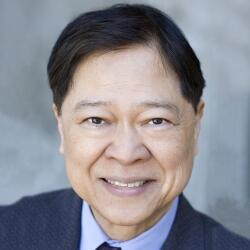
Gerardo "Buddy" Ungson, Ph.D.
Y.F. Chang Endowed Chair and Professor of International Business
International Business Professor Gerardo "Buddy" Ungson is deeply inspired by global experiences in both research and teaching. His formative years in the Philippines were a catalyst for his focus on international business, and his position as Y.F. Chang Endowed Chair at the Lam Family College of Business (LFCoB) has furthered Ungson’s deep exploration of his field as it relates to development across the world.
As an Endowed Chair, Ungson addresses four self-selected goals: sustaining an active research agenda; undertaking key roles in service; enhancing interdisciplinary research by involving other departments; and developing a center for research, learning, and engagement. “I still have some unrealized goals that I will achieve in the not-too-distant future,” he says. “I am deeply appreciative of the support provided by Chairman Chang.”
Ungson describes three key research areas that have defined his tenure at SF State, all addressing principal challenges faced in emerging and developing economies. His first area of focus is on strategies in emerging markets, which is embodied by an ongoing research collaboration with Sam Park, former President of Samsung China’s Economic Research Institute and Managing Director of Skolkovo-EY Institute for Emerging Market Studies, as well as a partnership with Ernst & Young. This research led to the development of Ungson’s award-winning book, Rough Diamonds: The Four Traits of Successful Breakout Firms in BRIC Countries, which received the 2013 Best Book on Globalization award from the Strategy + Business Journal.
Ungson also conducts research on poverty alleviation. He describes an “epiphany” in a meeting with development economist Sixto K. Roxas, which shifted his attention from the strategies of multinational corporations to alleviating and eradicating poverty in developing countries, challenging him to explore economic classics, philosophy, sociology, anthropology, and even New Age publications in order to effectively engage in developing economies.
Additionally, Ungson has partnered with Decision Sciences Professor Sada Soorapanth to examine the vulnerabilities caused by viruses in developing nations. During the COVID-19 pandemic, Ungson says the team redirected their study to the resilience of healthcare systems in Southeast Asia, adopting information technology as an anchor for evaluating the readiness of countries to respond.
He is now working on a fourth stream of research – digitalization in emerging markets – exploring the confluence of digital applications often referred to as the Fourth Industrial Revolution. “I am interested in how digitalization has become an imperative for rethinking conventional business theories about growth, development, and transformation not only in advanced economies, but in emerging and developing economies as well,” says Ungson.
Because global challenges must be addressed from a holistic perspective, Ungson sees an opportunity for students to gain a global perspective by studying International Business. “The field of international business is shifting from business enterprises operating overseas to globalizing and localizing forces that impact institutions and society,” he noted. Whether through double majors, minors, or electives, Ungson sees a huge benefit for students in interdisciplinary orientation. “Students espousing an interdisciplinary orientation such as international business, entrepreneurship, or even environmental sustainability are expected to also demonstrate employable disciplinary skills, which is the correct pathway,” he says. “Double majors can provide a winning ticket.” These complementary skills equip students to work effectively in an increasingly conscious global business landscape.
“As much as I value research, I take pride in being an educator,” Ungson says. He aspires to create a transnational face-to-face pedagogical platform that will use technology to engage students and practitioners in real time, allowing all to gain a global perspective on shared issues and lessons. For Ungson, the disruption of the pandemic has enhanced the need for a tool that facilitates academic connectedness across nations.
Social entrepreneurship, or ventures focused on improving a facet of societal welfare, is a concept Ungson views as good currency in today’s business world. As for how the value of social entrepreneurship is embodied by the LFCoB community, Ungson identifies several alumni who are pioneers in this era of social causes and sustainability. Among them is Sean Ansett (MBA, ‘98), director of At Stakes, a worldwide social entrepreneurial firm, where he studies the plight of workers in the world apparel industry who have been adversely affected by global supply chains. Another such alum is Paloma Lopez (MBA, ‘98) examines the deficiencies of the current food supply chain and aspires to bring about reform through her start-up, Future Fit Foods, which is built on an adaptation of a circular model that compels environmental sustainability. Included in this alumni group of social entrepreneurs is Greggory Cates (MBA, ‘06), who is working towards an organic civilization by developing innovative interventions, including an anti-malaria sensor system in South Africa.
In addition, Ungson recognizes several fellow faculty members for their noteworthy work addressing societal welfare issues. To name a few, Information Systems Professor Sameer Verma leads the “one laptop per child” initiative in developing countries, Professor of Labor and Employment Studies John Logan is at the forefront of worker rights and collective bargaining issues in the Bay Area, and Management Professor Geoff Desa studies the phenomenon of social entrepreneurship and sustainable ventures. Ungson notes there is significant research activity underway across the college examining healthcare issues, the student debt crisis, the emerging gig economy, societal engagement, and other issues that straddle social justice and the business world.
“For all too long, business education has not attended as much to poverty in emerging and developing economies,” Ungson reflects. “For me, ‘social justice’ means inclusion and engagement in ways that improve the welfare of all, but particularly for the poor and those unprivileged in society.”
Visit the International Business Department page to learn more about our programs and the variety of courses we offer in this field.